SHANDONG GEOROAD ENGINEERING MATERIALS CO., LTD

Textured Geomembrane – HDPE Single & Double-Sided Liner

Textured HDPE geomembrane for landfill slopes, tailings dams and containment. Single or double-sided, 0.75-2.0 mm. Request a datasheet and factory quote.

Additional information

Product Details:

Textured geomembrane is an HDPE liner with a roughened surface engineered to increase interface friction between the liner and the soil, geotextile or drainage layer above and below it. Where a smooth HDPE geomembrane can slide on a steep slope, a textured liner holds the cover soil in place. That is why textured geomembrane is specified for landfill side slopes and capping, tailings dams, heap leach pads, reservoir embankments and other containment works where stability matters as much as impermeability.

SHANDONG GEOROAD ENGINEERING MATERIALS CO., LTD manufactures textured HDPE geomembrane in single-sided and double-sided formats, in 0.75 / 1.00 / 1.50 / 2.00 mm nominal thicknesses (plus 1.20 and 1.35 mm embossed grades), with a 7 m roll width. Below you will find the full technical data, the difference between surface types, application guidance and how to request a lot-specific test certificate and quotation.

What Is a Textured Geomembrane?

A textured geomembrane is a polyethylene barrier whose surface has been deliberately roughened during manufacture. The texturing can be produced by co-extrusion (nitrogen-blown, sometimes called spray-on texturing) or by embossing a column-point pattern onto the sheet. Either process creates asperities that raise the interface friction angle against soil, geotextiles and geonets, reducing the risk of cover soil slippage on inclined liners.

The core sheet is still high-density polyethylene with carbon black, antioxidants and UV stabilisers, so chemical resistance, low permeability and long-term durability are the same as for a smooth liner of equivalent thickness. Texturing changes the surface, not the barrier function. Both single-sided (one textured face, one smooth face) and double-sided (both faces textured) versions are available.
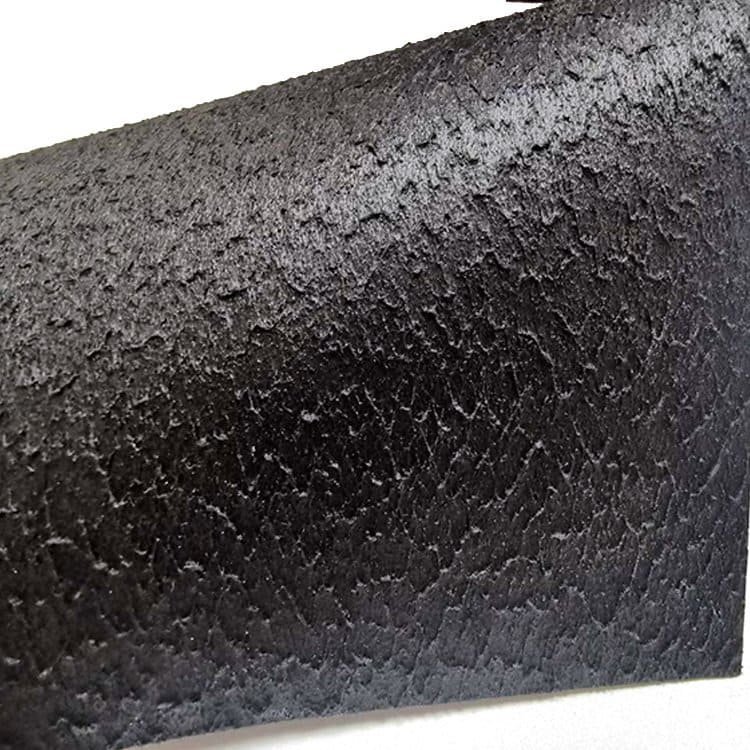
Nitrogen-textured HDPE geomembrane surface close-up showing random asperities
Co-extrusion / nitrogen-blown texturing produces random asperities that increase interface friction against soil, geotextiles and drainage layers.

Textured vs Smooth Geomembrane: Which Do You Need?

Criteria Textured geomembrane Smooth geomembrane
Interface friction High – designed to resist sliding on slopes Lower
Typical placement Side slopes, caps, embankments, steep base grades Flat base liners, pond bottoms, tanks
Cover soil stability Better retention of soil and protection layers Requires careful slope design
Welding Requires clean, dry textured surfaces and trial welds Simpler seam preparation
Relative cost Higher Lower

A common specification uses a textured liner on the slopes and a smooth HDPE geomembrane on the flat base. This keeps friction where it is needed without paying for texturing across the whole footprint. If your design involves steep side slopes or a low-friction interface such as a geonet or a smooth geotextile, textured material is normally the safer choice – always confirm against the project’s slope stability calculation and interface shear testing rather than a rule of thumb.
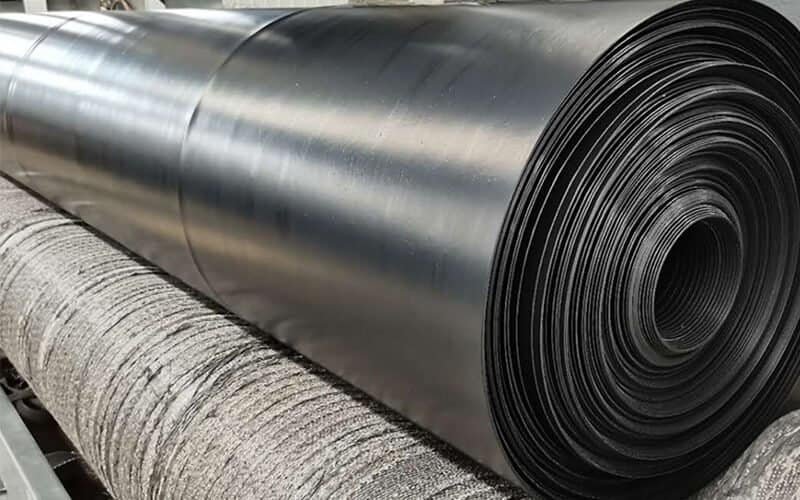
Smooth HDPE geomembrane roll resting on a textured geomembrane sheet for surface comparison
Surface comparison: a smooth HDPE geomembrane roll placed on a roughened textured sheet.

Single-Sided or Double-Sided Texturing?

Schematic comparing single-sided and double-sided textured geomembrane surface configurations
Surface configuration – schematic, not to scale. Asperity height and interface friction are confirmed per production lot.
  • Single-sided textured geomembrane – one textured face, one smooth face. Used when only one interface needs high friction, for example a liner laid on a prepared smooth subgrade with a cover soil above. The smooth face faces downward, the textured face upward.
  • Double-sided textured geomembrane – both faces textured. Used on steep slopes, in composite lining systems with geosynthetic clay liners, and wherever slippage could occur on either side of the sheet. Our standard specification sheets below cover double-sided products.
Single-sided textured geomembrane sample with the smooth back face folded over
Single-sided sheet: one textured face for the critical interface, one smooth face. The photograph shows the smooth reverse side at the folded corner.

Textured HDPE Geomembrane Specifications (Typical Values)

Data status – please read: the values below are typical values taken from our group’s product specification sheets. They are not contractual guaranteed minimums. For every order we issue a lot-specific Certificate of Quality; guaranteed minimums, asperity height and interface friction data are confirmed against that certificate and the project specification. Ask us for the current datasheet before finalising a design.

Co-extrusion / nitrogen-textured, double-sided (GMSH series)

Property Test method GMSH075 GMSH100 GMSH150 GMSH200
Thickness (mm) ASTM D5199 0.75 1.00 1.50 2.00
Density (g/cm³) ASTM D1505 0.940 0.940 0.940 0.940
Yield strength (kN/m) ASTM D6693 Type IV 8 10 16 21
Break strength (kN/m) ASTM D6693 Type IV 11 15 22 29
Yield elongation (%) ASTM D6693 Type IV 12 12 12 12
Break elongation (%) ASTM D6693 Type IV 700 700 700 700
Tear resistance (N) ASTM D1004 93 125 187 249
Puncture resistance (N) ASTM D4833 200 270 400 530
Stress crack resistance (h) ASTM D5397 (App.) 300 300 300 300
Carbon black content (%) ASTM D1603 2.0 2.0 2.0 2.0
Carbon black dispersion ASTM D5596 For 10 views: 9 in Categories 1 or 2, 1 in Category 3
Oxidative induction time OIT (min) ASTM D3895 100 100 100 100
Roll width (m) – 7 7 7 7
Roll length (m) – 280 210 140 105

Embossed / column-point textured, double-sided (GMSH series)

Property Test method GMSH120 GMSH135
Thickness (mm) ASTM D5199 1.20 1.35
Density (g/cm³) ASTM D1505 0.940 0.940
Yield strength (kN/m) ASTM D6693 Type IV 12 13
Break strength (kN/m) ASTM D6693 Type IV 13 15
Yield elongation (%) ASTM D6693 Type IV 12 12
Break elongation (%) ASTM D6693 Type IV 450 450
Tear resistance (N) ASTM D1004 150 160
Puncture resistance (N) ASTM D4833 230 250
Stress crack resistance (h) ASTM D5397 (App.) 300 300
Carbon black content (%) ASTM D1603 2.0 2.0
Oxidative induction time OIT (min) ASTM D3895 100 100
Roll width (m) – 7 7
Roll length (m) – 100 100
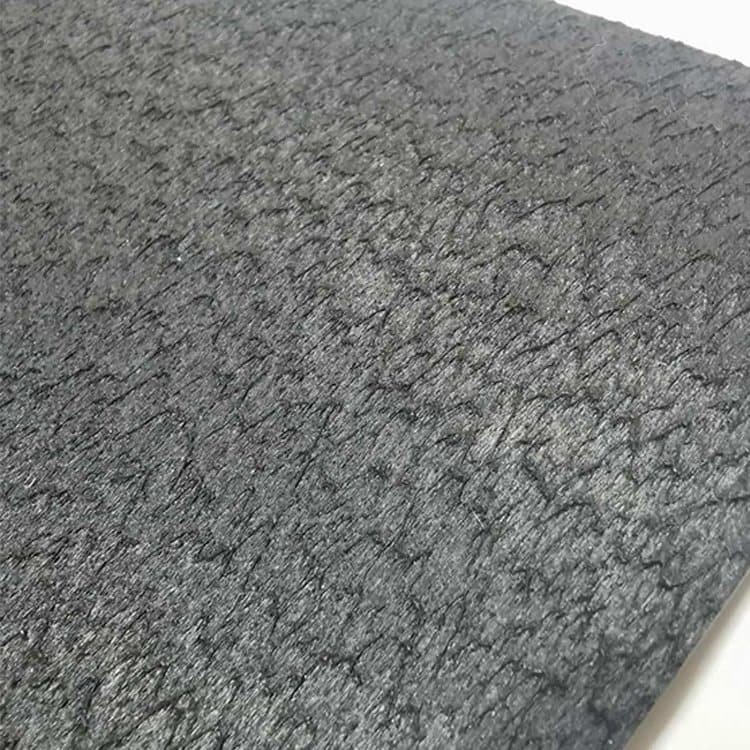
Roughened HDPE geomembrane surface detail, embossed or spray-textured finish
Roughened surface detail. The texture pattern varies with the production method (co-extrusion / nitrogen texturing or embossing).

Colours are normally black; other colours, roll lengths and single-sided texturing are produced to order. Asperity height (commonly measured to ASTM D7466) and interface shear strength are project-specific and are reported on the test certificate for the production lot – tell us the required value in your enquiry and we will confirm what can be supplied before quoting.

Test Methods and Standards

The properties above are measured using the ASTM test methods referenced by GRI GM13 for HDPE geomembranes: thickness (D5199), density (D1505), tensile properties (D6693 Type IV), tear (D1004), puncture (D4833), stress crack resistance (D5397), carbon black content (D1603) and dispersion (D5596), and oxidative induction time (D3895).

A note on wording that matters in tender documents: GRI GM13 is a material specification, not a certificate. Compliance for a specific lot is demonstrated by its test results, not by naming the standard. If your tender requires GRI GM13 values, send us the schedule and we will map each required minimum against our production test data and issue the corresponding Certificate of Quality with the shipment.

HDPE geomembrane blown-film extrusion line producing wide sheet
Wide HDPE sheet on the extrusion line. Each production lot is tested before its Certificate of Quality is issued.

Applications of Textured Geomembrane

  • Landfill side slopes and final capping – the main use case: high friction keeps cover soil and drainage layers stable on inclined grades.
  • Mining: tailings dams and heap leach pads – textured liners resist sliding under the load of ore and overlying drainage layers; also used in secondary containment around process ponds.
  • Reservoirs, canals and embankment dams – where the liner is placed on a slope and must stay put during filling and drawdown.
  • Tunnels and underground waterproofing – the rough surface gives a better mechanical key to protection layers and shotcrete systems.
  • Pond liners and biogas digesters on sloped bases – see our HDPE geomembrane range for flat-base and smooth options.
  • Slope protection systems – often combined with geocell erosion control or geotextile protection layers.
Geomembrane lining installed on a reservoir embankment slope
Lined embankment slope in a containment project. Textured liners are normally specified where cover soil stability on the slope is required.

Installation Notes

  • Keep the textured surface clean and dry before seaming; dust and moisture trapped in the asperities are the most common cause of poor seams.
  • Run trial welds at the start of each shift and after any change in weather, then verify seam peel and shear against the project specification before production welding continues.
  • Do not fold or crease double-sided sheet, and avoid dragging it over the subgrade – the textured face is the friction surface and should not be polished down by handling.
  • Place the protection geotextile promptly after seam testing and avoid prolonged exposure of the uncovered liner, following the project’s CQA plan.
Crew deploying geomembrane panels on a prepared soil slope
Panel deployment on a prepared slope. Keep the textured face clean and dry and run trial welds before production seaming.

Frequently Asked Questions

What is the main advantage of a textured geomembrane over a smooth one?

Friction. The roughened surface increases the interface friction angle against soil, geotextiles and drainage geocomposites, which is what keeps a liner system stable on side slopes and caps. The impermeability of the HDPE sheet itself is unchanged.

When should I choose double-sided textured geomembrane?

When sliding could occur on either face of the liner – steep slopes, composite systems with a GCL or geonet beneath, or where the design requires a minimum interface friction angle on both sides. If only the upper interface is critical, single-sided texturing is usually sufficient and more economical.

What thicknesses and roll sizes can you supply?

The standard textured range is 0.75, 1.00, 1.50 and 2.00 mm at 7 m roll width, with roll lengths from 105 m to 280 m depending on thickness (see the tables above). Embossed column-point sheet is available at 1.20 and 1.35 mm. Final thickness selection should follow the project specification – send us your drawings or schedule and our engineers will confirm the appropriate grade.

Do you provide test certificates and GRI GM13 documentation?

Yes. Every shipment can be accompanied by a lot-specific Certificate of Quality with measured thickness, density, tensile, tear, puncture, carbon black and OIT results. If your tender specifies GRI GM13 minimums, we map the required values against the production test data; we do not issue a generic “GM13 certificate” because GM13 is a specification, not a certification.

Can textured geomembrane be welded on site?

Yes, with proper surface preparation and trial welds. Textured surfaces need more careful cleaning than smooth sheet, and seam peel/shear tests should be run before and during production welding according to the project’s CQA plan.

How do I get a price?

Pricing depends on thickness, surface type (single or double-sided), quantity and destination. Use our contact page to send the specification and quantity, or message us on WhatsApp at +86 157 2528 6053 for a faster reply. We provide free samples and a technical datasheet before you commit to an order.

Request a Datasheet and Quotation

Tell us the application, thickness, single- or double-sided requirement, quantity and destination port. We will reply with the current specification sheet, a lot-specific test report where required, and a factory quotation. Contact GEOROAD for a textured geomembrane quote or reach us on WhatsApp: +86 157 2528 6053.

See also our full geosynthetics product range and the smooth HDPE geomembrane page for flat-base applications.

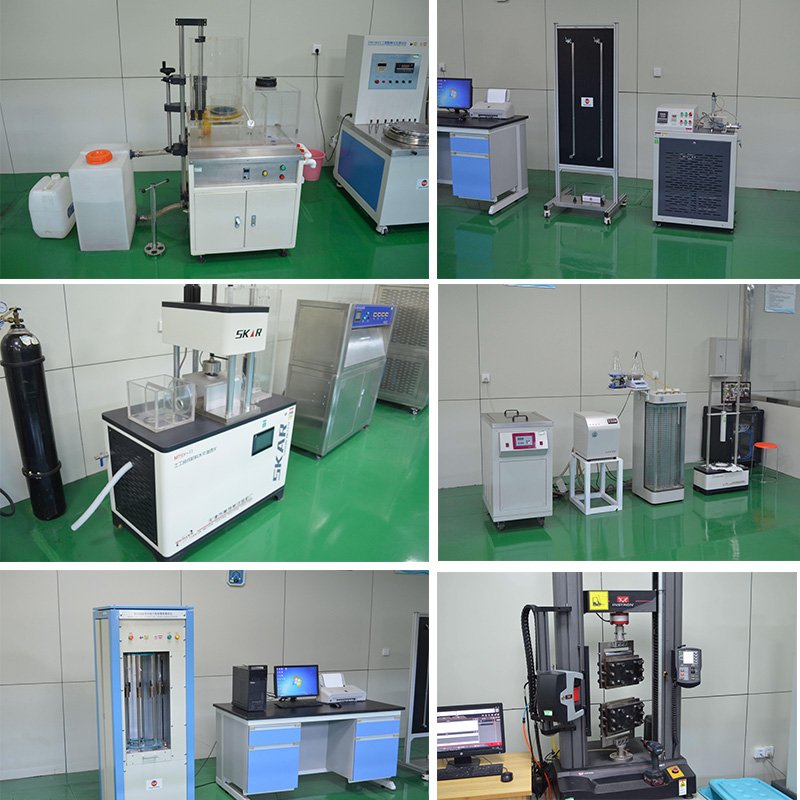
Factory Display;

Shandong groadgeo Engineering Materials Co., Ltd. is a company dedicated to the research and development, production, and sales of geotechnical materials and related engineering products, committed to providing high-performance engineering materials for industries such as roads, bridges, railways, water conservancy, and environmental protection. Main products; Geotextile, geomembrane, geogrid, geonet, geotextile bag, composite geomembrane, etc. The product is widely used in infrastructure construction, environmental protection, mining, landfill, road reinforcement and other fields. With advanced production technology and rich industry experience, the company has become one of the important suppliers in the geotechnical materials industry.

Product application;

1.Road foundation reinforcement: In the construction of infrastructure such as roads, airport runways, and railways, geotechnical materials are used to enhance the bearing capacity of the foundation and prevent uneven settlement. For example, geotextiles, geogrids, and geomembranes can be used to separate different soil layers, enhance soil stability, and reinforce foundations.
2.Dams, revetments, and reservoirs: Geotechnical materials are commonly used in hydraulic engineering for anti-seepage, drainage, and reinforcement purposes. Geomembranes, geotextiles, and geogrids are widely used for anti-seepage treatment of dams, lake and reservoir bottoms and sides, to prevent water infiltration and ensure structural stability.
3.Anti seepage and isolation of landfills: Geomembranes and geotextiles play a role in preventing seepage, isolation, and pollution at the bottom and sides of landfills. Geomembranes can effectively prevent the pollution of groundwater sources by leachate from garbage, while geotextiles provide filtration to prevent the infiltration of small particles.
Slope protection: In mountainous and sloping areas, geotechnical materials such as geotextiles, geonets, and geogrids are commonly used to prevent soil erosion. They effectively control soil erosion by stabilizing soil structure, reducing water flow erosion, and promoting vegetation restoration.

Construction case;

1.Geogrid: Used for reinforcing the shore to prevent wave erosion of soil and enhance the stability of protective walls.
2.Geotextile: Used to prevent soil erosion and help fix vegetation. It can improve soil stability, promote plant growth, and reduce soil erosion.
3.Geomembrane: As an anti-seepage material, it prevents seawater from invading the soil layer behind it, ensuring long-term effectiveness of protective measures.
4.Geonet: Used to enhance protective structures, especially in the reinforcement of vertical walls and slopes.

The importance of geotechnical materials in various complex environments and projects, whether it is infrastructure construction, water conservancy engineering, environmental protection, or soil reinforcement and waterproofing, geotechnical materials can play a key role. They help solve engineering problems and ensure the successful implementation of projects by improving soil properties, enhancing structural stability, protecting the environment, and improving durability.


Technical Advantages;

Shandong Groadgeo Engineering Materials Co., Ltd., with its strong technical strength, advanced production equipment, and rich industry experience, has become one of the leading enterprises in the geotechnical materials industry at home and abroad. Through continuous innovation and product optimization, Lutai Company not only occupies an important position in the Chinese market, but also establishes a good brand image in the international market.
1.Advanced production equipment: The company has introduced internationally advanced production equipment and adopted high-tech production processes to ensure that every product meets international quality standards.
2.Independent research and development capability: Lutai Company has a technically strong R&D team that continuously develops new products and innovates technology, striving to maintain technological leadership in the field of geotechnical materials.
3.Quality control: The company has a sound quality management system, and all products have passed ISO9001 quality management system certification to ensure stable and reliable quality of each batch of products.

FAQ;

Get quotation&technical support

Georoad Geogrid

Georoad offers OEM and ODM services to customize geogrids according to your needs.

Get Your Unique Quote

If you have any questions about our geogrids, kindly fill out the inquiry form below, and we will get back to you as soon as possible.

Georoad Geotextile

Georoad offers OEM and ODM services to customize geotextiles according to your needs.

Get Your Unique Quote

If you have any questions about our geotextiles, kindly fill out the inquiry form below, and we will get back to you as soon as possible.

georoad geotechnical materials

Georoad offers OEM and ODM services to customize geotechnical materials according to your nees.

Get Your Unique Quote

If you have any questions about geotechnical materials, kindly fill out the inquiry form below, and we will get back to you as soon as possible.