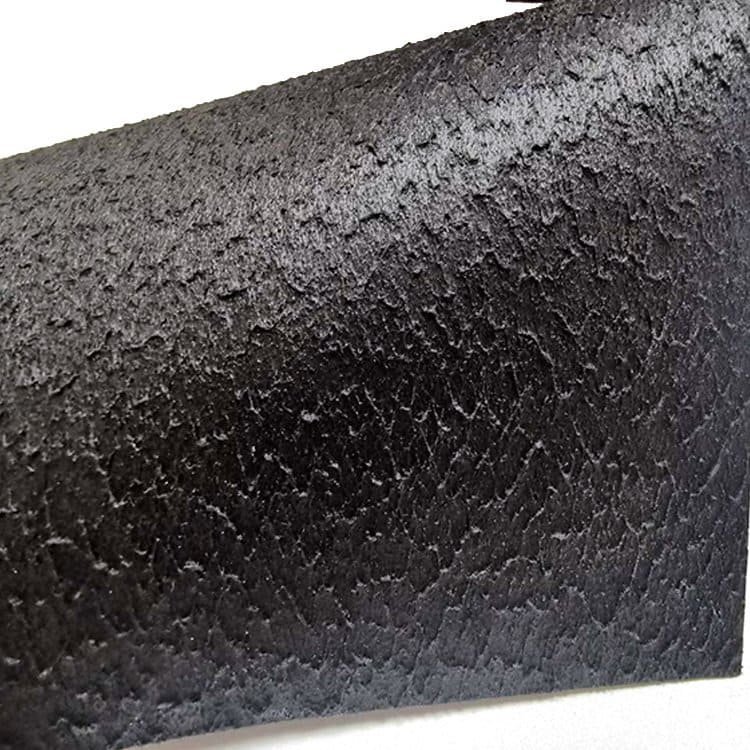
Textured geomembrane is an HDPE liner with a roughened surface engineered to increase interface friction between the liner and the soil, geotextile or drainage layer above and below it. Where a smooth HDPE geomembrane can slide on a steep slope, a textured liner holds the cover soil in place. That is why textured geomembrane is specified for landfill side slopes and capping, tailings dams, heap leach pads, reservoir embankments and other containment works where stability matters as much as impermeability.
SHANDONG GEOROAD ENGINEERING MATERIALS CO., LTD manufactures textured HDPE geomembrane in single-sided and double-sided formats, in 0.75 / 1.00 / 1.50 / 2.00 mm nominal thicknesses (plus 1.20 and 1.35 mm embossed grades), with a 7 m roll width. Below you will find the full technical data, the difference between surface types, application guidance and how to request a lot-specific test certificate and quotation.
A textured geomembrane is a polyethylene barrier whose surface has been deliberately roughened during manufacture. The texturing can be produced by co-extrusion (nitrogen-blown, sometimes called spray-on texturing) or by embossing a column-point pattern onto the sheet. Either process creates asperities that raise the interface friction angle against soil, geotextiles and geonets, reducing the risk of cover soil slippage on inclined liners.
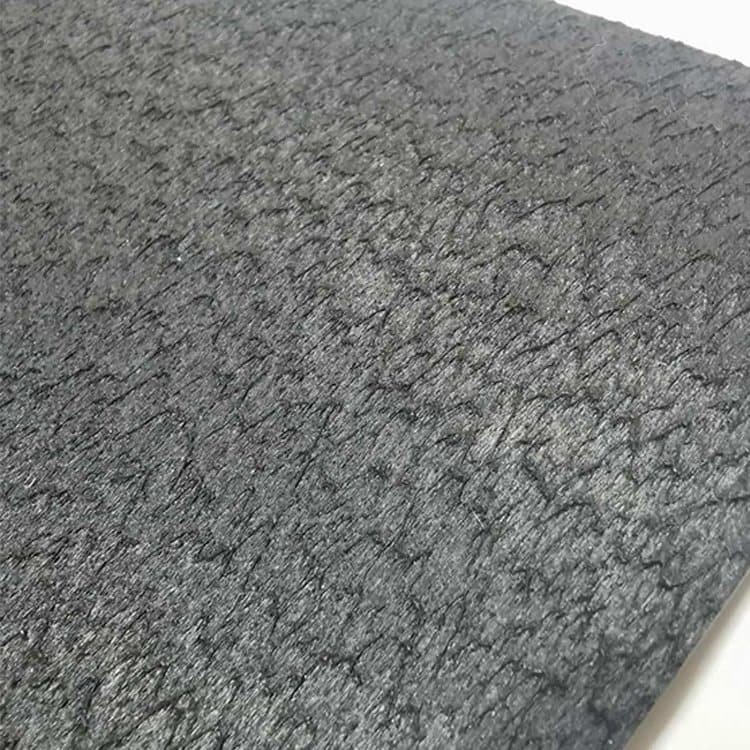
The core sheet is still high-density polyethylene with carbon black, antioxidants and UV stabilisers, so chemical resistance, low permeability and long-term durability are the same as for a smooth liner of equivalent thickness. Texturing changes the surface, not the barrier function. Both single-sided (one textured face, one smooth face) and double-sided (both faces textured) versions are available.
| Criteria | Textured geomembrane | Smooth geomembrane |
|---|---|---|
| Interface friction | High – designed to resist sliding on slopes | Lower |
| Typical placement | Side slopes, caps, embankments, steep base grades | Flat base liners, pond bottoms, tanks |
| Cover soil stability | Better retention of soil and protection layers | Requires careful slope design |
| Welding | Requires clean, dry textured surfaces and trial welds | Simpler seam preparation |
| Relative cost | Higher | Lower |
A common specification uses a textured liner on the slopes and a smooth HDPE geomembrane on the flat base. This keeps friction where it is needed without paying for texturing across the whole footprint. If your design involves steep side slopes or a low-friction interface such as a geonet or a smooth geotextile, textured material is normally the safer choice – always confirm against the project’s slope stability calculation and interface shear testing rather than a rule of thumb.
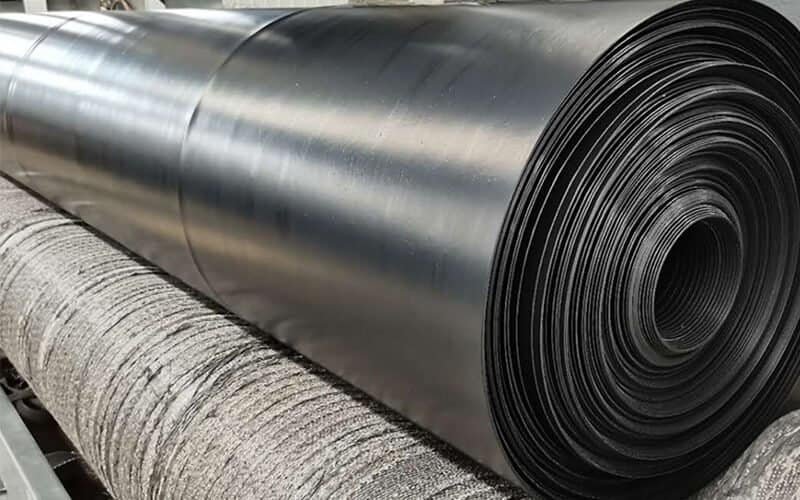


Data status – please read: the values below are typical values taken from our group’s product specification sheets. They are not contractual guaranteed minimums. For every order we issue a lot-specific Certificate of Quality; guaranteed minimums, asperity height and interface friction data are confirmed against that certificate and the project specification. Ask us for the current datasheet before finalising a design.
| Property | Test method | GMSH075 | GMSH100 | GMSH150 | GMSH200 |
|---|---|---|---|---|---|
| Thickness (mm) | ASTM D5199 | 0.75 | 1.00 | 1.50 | 2.00 |
| Density (g/cm³) | ASTM D1505 | 0.940 | 0.940 | 0.940 | 0.940 |
| Yield strength (kN/m) | ASTM D6693 Type IV | 8 | 10 | 16 | 21 |
| Break strength (kN/m) | ASTM D6693 Type IV | 11 | 15 | 22 | 29 |
| Yield elongation (%) | ASTM D6693 Type IV | 12 | 12 | 12 | 12 |
| Break elongation (%) | ASTM D6693 Type IV | 700 | 700 | 700 | 700 |
| Tear resistance (N) | ASTM D1004 | 93 | 125 | 187 | 249 |
| Puncture resistance (N) | ASTM D4833 | 200 | 270 | 400 | 530 |
| Stress crack resistance (h) | ASTM D5397 (App.) | 300 | 300 | 300 | 300 |
| Carbon black content (%) | ASTM D1603 | 2.0 | 2.0 | 2.0 | 2.0 |
| Carbon black dispersion | ASTM D5596 | For 10 views: 9 in Categories 1 or 2, 1 in Category 3 | |||
| Oxidative induction time OIT (min) | ASTM D3895 | 100 | 100 | 100 | 100 |
| Roll width (m) | – | 7 | 7 | 7 | 7 |
| Roll length (m) | – | 280 | 210 | 140 | 105 |
| Property | Test method | GMSH120 | GMSH135 |
|---|---|---|---|
| Thickness (mm) | ASTM D5199 | 1.20 | 1.35 |
| Density (g/cm³) | ASTM D1505 | 0.940 | 0.940 |
| Yield strength (kN/m) | ASTM D6693 Type IV | 12 | 13 |
| Break strength (kN/m) | ASTM D6693 Type IV | 13 | 15 |
| Yield elongation (%) | ASTM D6693 Type IV | 12 | 12 |
| Break elongation (%) | ASTM D6693 Type IV | 450 | 450 |
| Tear resistance (N) | ASTM D1004 | 150 | 160 |
| Puncture resistance (N) | ASTM D4833 | 230 | 250 |
| Stress crack resistance (h) | ASTM D5397 (App.) | 300 | 300 |
| Carbon black content (%) | ASTM D1603 | 2.0 | 2.0 |
| Oxidative induction time OIT (min) | ASTM D3895 | 100 | 100 |
| Roll width (m) | – | 7 | 7 |
| Roll length (m) | – | 100 | 100 |

Colours are normally black; other colours, roll lengths and single-sided texturing are produced to order. Asperity height (commonly measured to ASTM D7466) and interface shear strength are project-specific and are reported on the test certificate for the production lot – tell us the required value in your enquiry and we will confirm what can be supplied before quoting.
The properties above are measured using the ASTM test methods referenced by GRI GM13 for HDPE geomembranes: thickness (D5199), density (D1505), tensile properties (D6693 Type IV), tear (D1004), puncture (D4833), stress crack resistance (D5397), carbon black content (D1603) and dispersion (D5596), and oxidative induction time (D3895).
A note on wording that matters in tender documents: GRI GM13 is a material specification, not a certificate. Compliance for a specific lot is demonstrated by its test results, not by naming the standard. If your tender requires GRI GM13 values, send us the schedule and we will map each required minimum against our production test data and issue the corresponding Certificate of Quality with the shipment.


Friction. The roughened surface increases the interface friction angle against soil, geotextiles and drainage geocomposites, which is what keeps a liner system stable on side slopes and caps. The impermeability of the HDPE sheet itself is unchanged.
When sliding could occur on either face of the liner – steep slopes, composite systems with a GCL or geonet beneath, or where the design requires a minimum interface friction angle on both sides. If only the upper interface is critical, single-sided texturing is usually sufficient and more economical.
The standard textured range is 0.75, 1.00, 1.50 and 2.00 mm at 7 m roll width, with roll lengths from 105 m to 280 m depending on thickness (see the tables above). Embossed column-point sheet is available at 1.20 and 1.35 mm. Final thickness selection should follow the project specification – send us your drawings or schedule and our engineers will confirm the appropriate grade.
Yes. Every shipment can be accompanied by a lot-specific Certificate of Quality with measured thickness, density, tensile, tear, puncture, carbon black and OIT results. If your tender specifies GRI GM13 minimums, we map the required values against the production test data; we do not issue a generic “GM13 certificate” because GM13 is a specification, not a certification.
Yes, with proper surface preparation and trial welds. Textured surfaces need more careful cleaning than smooth sheet, and seam peel/shear tests should be run before and during production welding according to the project’s CQA plan.
Pricing depends on thickness, surface type (single or double-sided), quantity and destination. Use our contact page to send the specification and quantity, or message us on WhatsApp at +86 157 2528 6053 for a faster reply. We provide free samples and a technical datasheet before you commit to an order.
Tell us the application, thickness, single- or double-sided requirement, quantity and destination port. We will reply with the current specification sheet, a lot-specific test report where required, and a factory quotation. Contact GEOROAD for a textured geomembrane quote or reach us on WhatsApp: +86 157 2528 6053.
See also our full geosynthetics product range and the smooth HDPE geomembrane page for flat-base applications.